domingo, 12 de septiembre de 2021
Considerando objetos DOO
domingo, 22 de agosto de 2021
La planificación y gestión de proyectos
La planificación y gestión de proyectos incluye implementar
planes de acción para todas las fases del proyecto. En este sentido, decimos
organización sistemática porque requiere una serie de pasos para ejecutarse.
Además, necesita saber lo que tiene o puede tener para lograr su objetivo, en
este caso estaremos mencionando la estimación de proyectos y la organización
del equipo de trabajo
Estimación
La estimación es un proceso analítico imparcial con un objetivo de exactitud y para poder planificar y gestionar un proyecto se debe tener en cuenta las estimaciones de diversos factores como los costos, duracion, metas, compromiso, etc.
Consideraciones basadas en estimaciones precisas:
- Crear un cronograma detallado
- Identificar el camino crítico
- Priorizar la funcionalidad a entregar
- Partir el proyecto en iteraciones
Factores importantes en la estimación:
- No incluir alcance de proyecto
- Estimar tamaños
- Economía a escala, al producir en mayor cantidad se reducen los costos
- Factores del personal
La experiencia del equipo en el lenguaje y herramientas - 40% de impacto en productividad general.
Herramientas de soporte y ambiente de programación – hasta 50% de impacto.
Algunos lenguajes generan más funcionalidad por LOC (Líneas de Código).
Trabajar en lenguajes interpretados tiende a ser (hasta 2 veces) más productivo que en lenguajes compilados.
No existe una forma sencilla de estimar el esfuerzo requerido para desarrollar un sistema de forma precisa:
1. Las estimaciones iniciales parten de la definición imprecisa de requisitos por parte del usuario.
2. El software a desarrollar a menudo se ejecutará sobre entornos desconocidos por el equipo de desarrollo o bien utilizará tecnología de punta.
3. Las personas que van a formar parte del proyecto (y sus habilidades) pueden ser desconocidas.
La productividad de los programadores en los proyectos es muy difícil de saber, pero se puede realizar una medición, y se hace por medio de las líneas de código.
Esta forma de medición tiene sus ventajas y desventajas como:
Ventajas:
Fácil de medir automáticamente a partir del código.
Permite comparar proyectos y estimar proyectos futuros basándose en datos de proyectos pasados.
La mayoría de las herramientas de estimación basan sus estimaciones de esfuerzo y duración en LOCs.
Desventajas:
Para medir se precisa que el código esté construido
Sujeto a variaciones personales/grupales y estilos de programación.
Deseconomía de escala
Productividad varía según tipo de sw.
No pueden usarse para estimar asignaciones de tareas, porque productividad varía entre programadores.
Requisitos, diseño y testing no producen LOCs
Depende del lenguaje:
- Dificultad para medir productos implementados en más de un lenguaje.
- Difícil comparar proyectos en distintos lenguajes.
La organización y recursos humanos.
Para determinar el calendario del proyecto y estimar el esfuerzo y costo asociados, debemos saber:
Cuánta gente va a estar trabajando en el proyecto
Qué tareas van a desarrollar y
Qué habilidades y experiencia deben tener.
Otro factor a tener en cuenta con las estimaciones son los equipos de trabajo o mas bien la selección de equipos de trabajo.
En la entrevista el aspirante tiene que mostrar algunas características para desempeñar el trabajo como:
- Capacidad para desempeñar una tarea
- Interés en el trabajo
- Experiencia con aplicaciones similares, herramientas, lenguajes, técnicas y ambiente de desarrollo • Capacitación - estudios
- Capacidad para comunicarse con otros y compartir la responsabilidad
- Capacidad de supervisión
- Capacidad para resolver problemas
- Adaptabilidad – Capacidad de aprender, aceptar y asimilar cambios.
- Capacidad para resistir cierta cantidad de tensión.
- Personalidad
- Organización del modo de trabajo.
- Asignar el personal
- Asignar/ajustar los roles y responsabilidades
- Definir/comunicar los objetivos
- Estimación del trabajo que puede realizar el personal
- Planificación de las tareas a realizar por cada miembro del equipo.
- Control de las actividades del personal
- Motivar
- Facilitar la comunicación entre los integrantes
- Resolución de problemas haciendo uso del personal disponible
- Brindar retroalimentación respecto a los logros
domingo, 25 de julio de 2021
El porqué de la ingeniería de software
La ingeniería de software es básicamente una ciencia que estudia el desarrollo, la creación y el mantenimiento de software de calidad y de confianza, esto se logra gracias a métodos y técnicas que han venido desarrollando a base de pruebas y errores, también se le conoce como producción de software ya que estos métodos buscan obtener la mayor rentabilidad en el mercado.
La ingeniería de software empezó a mencionarse como termino por primera vez en 1968, pero sin embargo ya se venia apareciendo a finales de la década 1950, debido a la llamada crisis del software que llego a estimular los avances a la ingeniería del software.
La crisis del software fue una etapa que se vivió un poco mas enfatizada entre 1960 y 1980, esta crisis realmente trato de una situación de producción del software insostenible debido a que en ese entonces no se habían desarrollados técnicas para la construcción del software, esto afecto directamente al cliente final ya que los productos resultaban ser malos y demasiados costosos, esto creo un mercado con poca tasa de rentabilidad y se tenia que buscar una solución y esto no paso hasta 1968 en una conferencia de la OTAN donde Friedrich L. Bauer hablo por primera vez sobre toda la problemática del desarrollo de software desde su deficiencia como sistemas, hasta los grandes costos que representa su desarrollo, ahí también se propuso la creación de la nueva rama ingeniería de software para dar solución al problema.
La ingeniera del software también ha tenido que superar muchas etapas de formación como toda rama de las ciencias, una de la mas complejas es la de la aplicación del software en diversas áreas, ya que los informáticos son expertos en programar, pero no conocen nada sobre la contabilidad, no son experto en finanzas y mucho menos en arquitectura, cuando a los ingenieros de software les piden desarrollar sistemas para un área diferente a la suya se entra en un factor de incompetencia y es necesario que alguien experto en esa área aborde el equipo y comience a dar su opinión y de igual manera se entra en la incompetencia ya que el experto no conoce nada sobre la programación y sus ideas no pueden ser aplicadas, para esto de igual manera se crearon métodos que ayudasen a solucionar problemas de este tipo.
El software también conlleva un papel muy importante con la ética y responsabilidad, y es por eso que los software tiene que ir de la mano con la ley local que se aplica y así no entrar en controversia con los estados y claro sus usuarios.
La ingeniería del software tiene como objetivo los siguiente:
Mejorar el diseño del software para mejorar su adaptabilidad
promover la mejor calidad del software
Tener mejor exactitud con los costos y tiempos de desarrollo
Mejorar la organización de equipos de trabajo
martes, 23 de agosto de 2016
Terms Of Computer
Direct access
The shortcut is a concept used in Microsoft Windows operating systems to refer to a file or object whose content contains instructions that redirect to another file system file or to a network location. He is represented by an icon with an arrow at the bottom left side of the icon.Such files contain location information (program or document), usually represented by a custom icon. They are not editable using a text editor; You can only be edited from Windows Explorer.
Database
It is called database information banks containing data on various topics and categorized differently, but share with each other some kind of link or relationship that seeks to sort and classify them together.Bit
Bit stands for binary digit (ie of 'bit' in Spanish referred to as bit, and to a lesser extent as bit). A bit is a binary digit numbering system. The storage capacity of a digital memory also measured in bits, because this word has several meanings.Data buffer
In computer science, a buffer (English, buffer) is a memory space in which data is stored temporarily, usually for single use (generally use a FIFO queue system); its main use is to prevent the program or resource that requires either hardware or software, run out during data transfer (input / output) of irregular data or processing speed.Byte
Byte (B) 1 2 (pronounced [bait] or [ 'bi.te]) is the basic unit of information used in computing and telecommunications, and is equivalent to an ordered set of bits (usually 8 bits, set April 3 May 6 7 8 9 10 which in Spanish also called octet).
Cache
In computing, cache memory is fast access to a computer, which temporarily stores the newly processed data (information).A cache is a special memory buffer that have computers, which functions similarly to the main memory, but is smaller and faster access. It is used by the microprocessor to reduce access time to data located in the main memory that are used most frequently.

CD-R
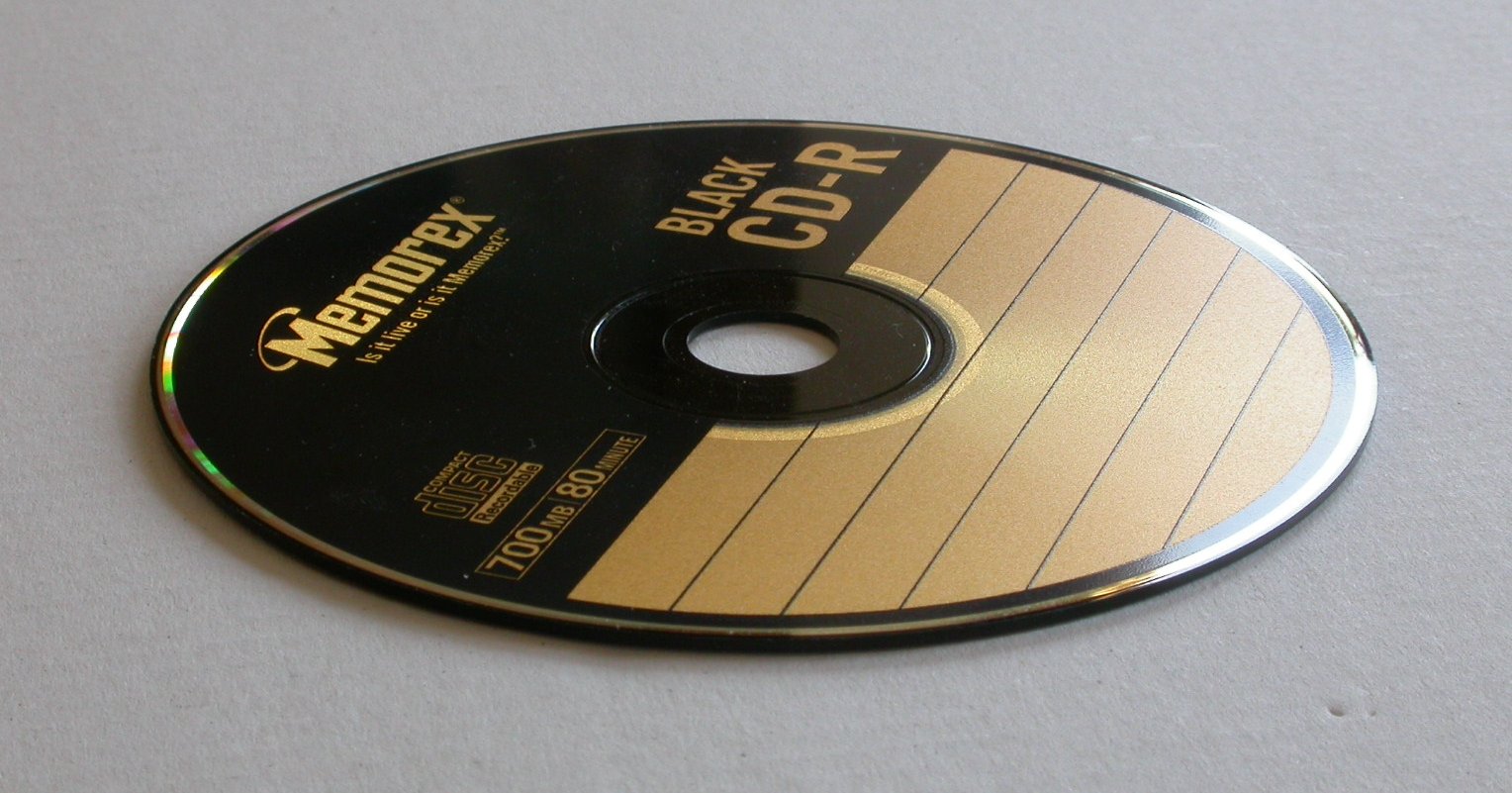
A CD-R is a recordable compact disc format. (Compact Disc Recordable = Compact Disc Recordable). They can be recorded in multiple sessions, however aggregated information can not be erased or overwritten, instead you must use the free space left by the immediately previous session.
CD-ROM
A CD-ROM, also cederrón1 (English acronym Compact Disc Read-Only Memory) is a compact disc using laser beams to store and read large amounts of information in digital format. The CD-ROM standard was established in 1985 by Sony and Philips2. It belongs to a set of colorful books known as Rainbow Books that contains the technical specifications for all CD formats.
CD-RW
The compact disc-rewritable, known by the acronym CD-RW (English Compact Disc - ReWritable, originally R and W were used as the attributes of the CD, which means "read" and "write", reading and writing) is a type support digital optical disc used to store any kind of information.This type of CD can be recorded multiple times, as it allows stored data to be deleted.
Cookie
A cookie, computer cookie or cookie is a small information sent by a website and stored in the user's browser so that the website can consult the previous user activity.Its main functions are:
You take control of users: When a user enters their username and password, a cookie is stored so you do not have to be introducing them to each page server. However, a cookie does not identify a person, but to a combination of computer-computer class-user browser.
Getting information on the user's browsing habits, and attempted spyware (spyware), by advertising agencies and others. This can cause privacy and is one of the reasons why cookies have their detractors.
Cracker
The term cracker (English cracker, and East to crack, 'break', 'fail') is used to refer to people who "break" a system security.1 Crackers may be motivated by a multitude of reasons, including profit, protest, or the desafío.2 Mostly, it is understood that the crackers are engaged in unauthorized editing of proprietary software. However, it should be understood that although the binary executables are one of the main objectives of these people, a web application or any other computer system represent other types of attacks that similarly can be considered acts of cracking.
DIMM
SDRAM memory modules in DIMM format (two DIMM SDR SDRAM PC133 modules).
DIMMs (stands for dual in-line memory module, translatable as "memory module with dual contacts") are, like its predecessors SIMM RAM modules that plug directly into slots on the motherboard personal computers and consist of small printed circuit boards containing memory integrated circuits. DIMMs are externally recognizable by having each contact (or pin) of one of its separate sides opposite each other, unlike the SIMM that each contact is connected to its opposite. The physical layout of the DIMM doubles the number of different contacts with the bus.
Harddrive unit
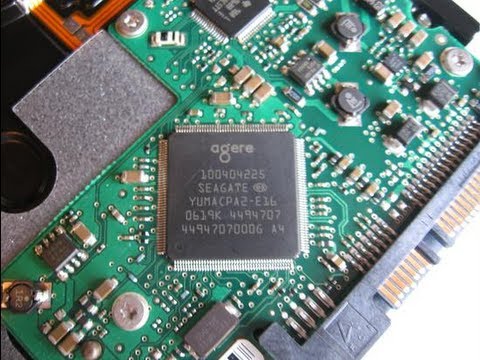
In computing, the hard drive or hard disk drive (in English: Hard Disk Drive, HDD) is a data storage device that uses a magnetic recording system for storing digital files. It consists of one or more plates or hard disks, united by a common shaft rotating at high speed inside a sealed metal box. On each plate, and on each of its faces, a head read / write floating on a thin sheet of air generated by the rotation of the disks is placed. It is nonvolatile memory.
Pointing device
A pointing device is a hardware component (more specifically a human interface device) that allows the user to enter data into a computer space.Systems computer-aided design (CAD) and gifted teams graphical user interface (GUI) assisted allow the user to control and provide data to the computer using physical movements of the device (point, click, drag), mainly by moving a mouse hand on the actual surface of a table and activating the switches in this. Peripheral movements are reflected on the screen as the pointer or cursor movements and other visual changes.

DRAM
DRAM stands for the English word Dynamic Random Access Memory, which means dynamic memory random (or dynamic RAM) access, to name a type of RAM technology based on capacitors, which lose their charge gradually, requiring a dynamic refresh circuit that every certain period, check that charge and replenished in a refresh cycle. In opposition to this concept comes the SRAM (static RAM), with which it is called the type of RAM semiconductor-based technology, while still powered, no need to refresh.
DVD
The DVD is a type of optical disk for data storage.
The DVD1 abbreviation stands for Digital Versatile Disc2 (Digital Versatile Disc), so that both acronyms (in Spanish and English) match. In the beginning, the "V" intermediate referred to video (digital videodisc) due to its development as a replacement for VHS format for video distribution to households
Driver
A driver or device driver is the software that communicates with the operating system peripherals. For example, a sound card can output an audio signal or take audio from the outside, a video card is capable of sending video signal to a monitor to show the desktop of a system, a mouse is able to mobilize an arrow virtual on screen, etc.Firewall
Firewalls can be implemented in hardware or software, or a combination of both. Firewalls are frequently used to prevent unauthorized Internet users from accessing private networks connected to the Internet, especially intranets. All messages entering or leaving the intranet pass through the firewall, which examines each message and blocks those that do not meet the specified security criteria. It is also common to connect the firewall to a third network, called demilitarized zone, or DMZ, where the servers in the organization that must remain accessible from the external network are located.
Firmware
A very common device firmware: the television remote control.
A typical view of computer architecture as a series of abstraction layers: hardware, firmware, assembler, kernel, operating system and applications
Read-only memory containing the BIOS of an old motherboard.
The firmware is a computer program that establishes the lowest level logic that controls the electronic circuits of a device of any kind. It is tightly integrated with the electronic device, so that is the software that has direct interaction with the hardware, thus being responsible for external control to execute instructions correctly.
In short, a firmware is software that manages the hardware physically.
The BIOS program a computer is a firmware whose purpose is to activate a machine from its power and prepare the environment to load an operating system into RAM.
GIF
developer
CompuServe
General information
.gif File extension
MIME type of image / gif
Type code GIF
Uniform Type Identifier com.compuserve.gif
Magic number GIF87a / GIF89a
Type format raster graphics
Open format?
[Edit data in Wikidata]
Graphics Interchange Format, GIF (CompuServe GIF) is a graphics format widely used on the World Wide Web, both for images and for animations.
The format was created by CompuServe in 1987 to provide a color image format for their file downloading areas, replacing their earlier RLE format in black and white. GIF became popular because he could use the LZW compression algorithm (Lempel Ziv Welch) to perform image compression, which was more efficient than the algorithm Run-length encoding (RLE) used by PCX and MacPaint formats. Therefore, large images could be discharged within a reasonable period of time, even with very slow modems.
Gigabyte
Information units (byte)International System (decimal) ISO / IEC 80000-13 (binary)
Multiple (symbol) multiple SI (symbol) ISO / IEC
kilobyte (kB) 103 kibibyte (KiB) 210
megabyte (MB) 106 mebibyte (MiB) 220
gigabyte (GB) 109 gibibyte (GIB) 230
terabyte (TB) 1012 tebibyte (TIB) 240
petabyte (PB) 1015 pebibyte (GdP) 250
exabyte (EB) 1018 exbibyte (EIB) 260
zettabyte (ZB) 1021 zebibyte (ZiB) 270
yottabyte (YB) 1024 yobibyte (YIB) 280
See also: Nibble • • octal byte
A gigabyte is a unit of information storage whose symbol is the GB, equivalent to 109 (one thousand million- 1,000,000,000) bytes. The term comes from the Greek giga / guígas / which means "giant". In colloquial language, "gigabyte" is often abbreviated as giga: "This computer has 2 gigabytes of RAM"

Hacker
The term hacker has different meanings. According to the dictionary of hackers, 1 is any individual who is dedicated to program enthusiastically, that is an enthusiastic expert of any kind, who believes that making information accessible to all is an extraordinary well.2 According to Eric Raymond the main reason that these people have to create software in their spare time, and then distribute them free of charge, is to be recognized for their iguales.3 the term hacker was born in the second half of the twentieth century and its origin is linked to the clubs and laboratories of MIT.Hardware
good articleTipical Hardware of a PC:
1. Monitor.
2. Main board.
3. Microprocessor (CPU) and socket.
4. A RAM module and three slots.
5. Two expansion cards and three slots.
6. Power supply.
7. Optical (CD, DVD, BD).
8. Hard disk drive or solid state drive.
9. keyboard.
10. Mouse.
The term hardware refers to all physical parts of a computer system; its components are: electrical, electronic, electromechanical and mecánicos.1 are cables, cabinets or boxes, peripherals of all kinds and any other physical element involved; contrary, the software is intangible and is called software.
HTML
HTML stands for HyperText Markup Language (hypertext markup language), refers to markup language for developing web pages. It is a standard that serves as a reference for the software that connects to the development of web pages in different versions, defines a basic structure and code (called HTML) for defining content of a web page, including text, images, videos , games, among others. It is a standard by the World Wide Web Consortium (W3C) or WWW Consortium, an organization dedicated to the standardization of almost all technologies related to the web, especially in relation to their writing and interpretation. the most important being its crucial web language invention in the emergence, development and expansion of the World Wide Web (WWW) is considered. Is the standard that has been imposed on display of web pages and is the one that all current browsers have adopted.

HTTP
.
Internet
The Internet (or, again, the internet) 3 is a decentralized set of communications networks interconnected using the family of TCP / IP protocols, which ensures that the heterogeneous physical networks that comprise a unique global logical network. Its origins date back to 1969, when the first connection of computers, known as ARPANET, between three universities in California (United States) was established.Intranet
An intranet is a computer network that uses Internet Protocol technology to share information, operating systems, or computing services within an organization. This term is used in contrast to Extranet, a network between organizations, and instead refers to a network within an organization. Sometimes the term refers only to the internal organization of the website, but may be a more extensive part of the infrastructure of information technology organization, and may be composed of several local area networks. The goal is to organize the desktop of each individual with minimal cost, time and effort to be more productive, profitable, timely, secure and competitive.Java
Java is a programming language for general purpose concurrent object oriented which was specifically designed to have as few implementation dependencies as possible. His intention is to allow application developers to write the program once and run on any device (known in English as WORA, or "write once, run anywhere"), which means that the code is executed on a platform You not have to be recompiled to run on another. Java is from 2012, one of the most popular programming languages in use, particularly for client-server applications web, with some 10 million users reported.